Air Duct Repair in Bridgewater, NJ
AMG Duct Cleaning Bridgewater repairs the ductwork that leaks, sags or comes apart in the houses around Bridgewater: a crushed flex run above the garage, a branch that slipped off its collar behind a finished ceiling, a length of insulated duct that sat in floodwater. Every repair starts by finding where the air is going instead of where it was meant to go.
Most of the duct damage in these towns comes from the way the houses were built and what they have been through since. In the two-story houses that went up across Bridgewater, Bernards and Warren in the 1980s and 1990s, the upstairs system often runs through the attic in flexible duct, where it gets stepped on, flattened under storage, or pulled loose when someone blows in more insulation. In the older houses of Bridgewater and in the 1950s and 1960s houses that make up most of Middlesex, the branch runs above a lower-level ceiling were often closed in when the space was finished, sometimes with a joint already open.
Water is the other story. Bound Brook, South Bound Brook and Middlesex sit low along the Raritan and the Green Brook, and their basements have taken floodwater in more than one storm: Hurricane Floyd put downtown Bound Brook under deep water, and after the remnants of Ida, Middlesex homeowners and renters were pointed to FEMA for help. Ductwork that sat in that water does not all fail the same way, and sorting what can be repaired from what has to be replaced is the first job on a visit there.
Attic flex over bonus rooms and bedrooms
In the bigger colonials, the uncomfortable room is often the one over the garage: hot in July, cold in January, a weak breath of air at the register. Its supply is usually the longest run in the attic system, and flex duct over that distance sags between supports, kinks at the turns and gets flattened under boxes. The register tells part of the story. The attic tells the rest, so the crew traces the run from the plenum all the way to the boot before deciding anything.
Repair there means supporting the run again with proper straps so it stops sagging, cutting out the crushed length, and joining new duct with clamps and sealant rather than tape alone. Where a run was stretched too far for its diameter or snakes around the trusses, a shorter reroute does more than a patch. Insulation goes back around every repaired section, because in August or January an attic is outdoors as far as the duct is concerned.
Finished lower levels and hidden joints
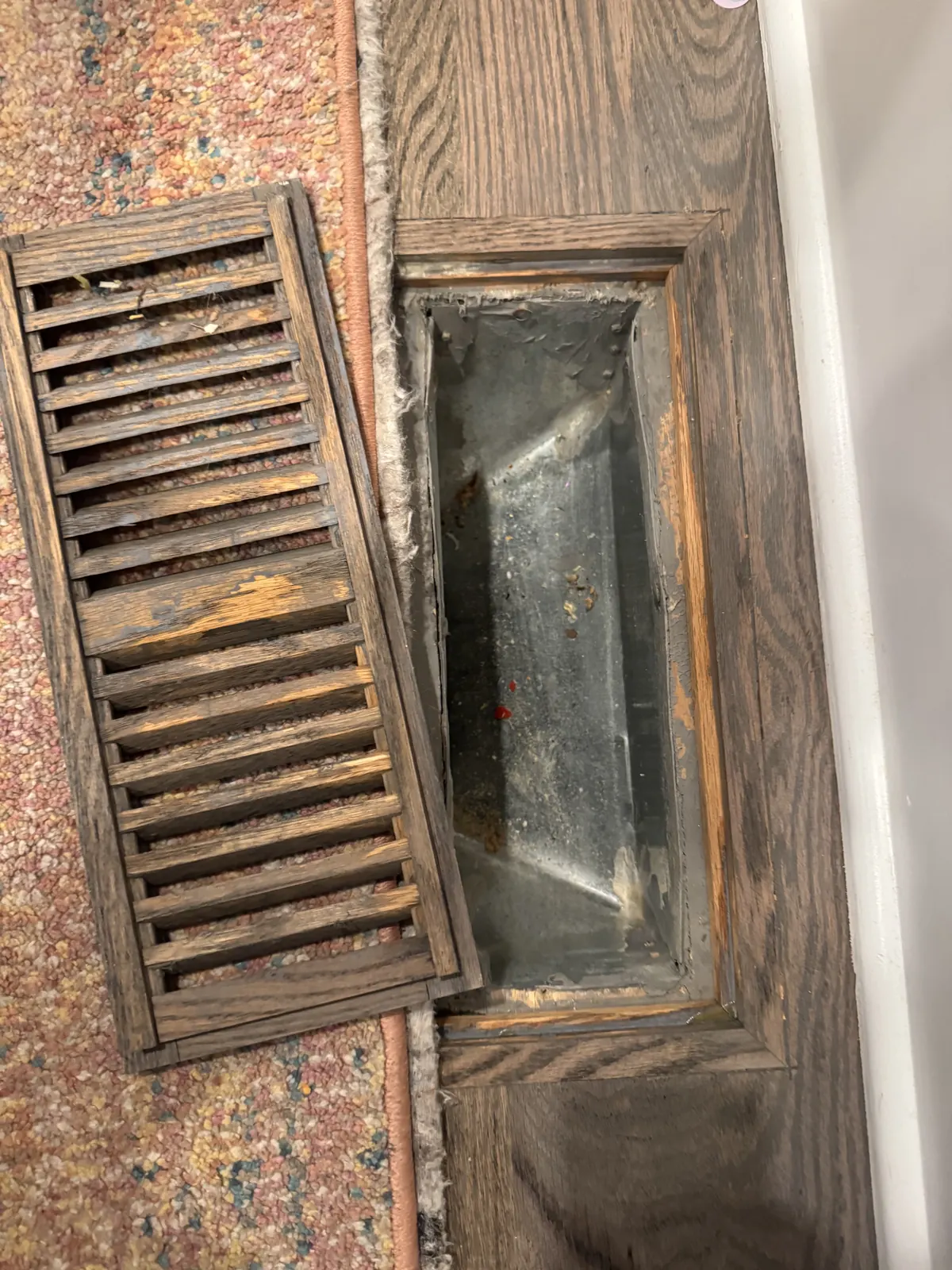
In the ranches, split-levels and bilevels of the 1950s through the 1970s, the trunk line and its branches run under the main floor, and many of those basements and lower levels were finished long after the house was built. The drywall ceiling went up over whatever was there: a branch half off its takeoff, a joint that had pulled apart, a panned joist return with open ends. Supply leaks dump heated or cooled air into the ceiling cavity, return leaks pull basement air into the system, and a room upstairs goes weak with nothing visibly wrong. The furnace gets blamed, and the furnace is often fine.
Access is the constraint. The crew works through registers, return grilles and any access panel first, and opens the ceiling only where a joint cannot be reached another way, keeping the opening small and square so it closes with a simple patch. You hear about any cut before it is made. Loose joints are fastened and sealed with mastic, open takeoffs are secured to the trunk, and a return that draws from the wrong space is closed off or given a proper boot.
Ducts that sat in floodwater
After a flood the first question is what the duct is made of. Bare galvanized trunk and branch pipe can often stay, since once dry it can be cleaned, checked for rust at the seams and sealed again. Insulated duct is a different case. The EPA treats insulation that has been soaked or has grown mold as something to take out and replace, because it cannot be cleaned effectively, and that takes in insulated flex, lined trunk and fiberglass duct board.
In a flooded basement the furnace may have been replaced afterward while the old ductwork stayed in place. The connection where new equipment meets old duct is a weak point, and so is any run that dropped when its hangers rusted. The crew checks both, shows you which sections are sound metal and which are soaked insulation, and prices repair and replacement separately so the choice stays yours.
Repair or replace, and how the call gets made
Repair makes sense when the system is sound and the damage is local: a crushed length, a few open joints, sagging runs, a disconnected boot. Replacement makes sense when the duct material has failed across the board, when insulated runs took water, or when the layout never delivered air to a room in the first place, which is air duct installation rather than repair. If air duct cleaning is on the list too, the leaks get closed first, so the clean system is not drawing attic or basement dust back in the next day.
Every repair ends with a check of airflow at the registers that were weak, so the result can be felt at the vent. AMG, a veteran owned company, is licensed and insured as New Jersey Home Improvement Contractor 13VH13654300 and books repair visits 8 AM to 8 PM, 7 days a week. The free estimate lists each repair by where it is, attic, lower level or basement, so nothing is bundled out of sight.
What is included
- Airflow checked at the weak registers before any work
- Each problem run traced from the plenum to its boot
- Crushed or kinked flex cut out and replaced
- Sagging runs supported again with proper straps
- Joints fastened and sealed with mastic
- Loose takeoffs and boots secured to the trunk
- Insulation restored around every repaired section
- Flood-soaked insulated duct marked for replacement
Questions and answers
Why is one bedroom always weaker than the rest?
Usually because its supply run is the longest, the most crushed, or partly disconnected. In the two-story houses around Bridgewater, Bernards and Warren that room is often over the garage and fed by attic flex, so the crew starts there. A run that is sound but too small for the room is a design problem, and new ductwork is the fix for that.
Is foil tape enough to seal a duct leak?
Not on its own at most joints. The joint is fastened first so it cannot pull apart, then sealed with mastic, a paste brushed over the seam that holds up as the metal heats and cools. Listed foil tape has a place on some seams; cloth duct tape has none.
Our basement flooded. Do all the ducts have to come out?
Not all of them. Bare metal duct that has dried can usually stay after it is cleaned and resealed, while duct with soaked insulation, lined duct and duct board are replaced. The crew marks which runs fall on which side before anything is quoted.
Our lower level is finished. Can you reach the ducts without tearing out the ceiling?
Yes, most of the time through registers, grilles and access panels. When a joint cannot be reached that way, the crew opens the smallest practical piece of ceiling at that spot. You are told first and decide before any cut.
Which signs point to leaking ductwork rather than a tired furnace?
Rooms that stay weak while others are fine, an attic or basement that runs warm in winter, and dark dust streaks at joints or on duct insulation are the usual signs. A furnace that seems to run constantly can point the same way. Following the runs on the walk-through confirms where the air is escaping.
More questions and answers about our work
Air Duct Repair across the Bridgewater area
We provide air duct repair in the Bridgewater area. Choose your town for local details.
Ready for cleaner air?
Tell us about your home and get a free estimate.